Spider veins are red and purple blood vessels that occur in patches on the legs and face. The network of vessels is often as delicate as a spider’s web, which is how they get their name, but the patches also resemble tiny sunbursts, branching trees or just plain old lines.
Spider veins (referred to medically as telangiesctasias) and varicose veins are not the same.Whereas varicose veins are large, swollen and occur singularly on the legs and the face, spider veins are delicate and tend to develop in clusters. Spider veins are primarily a cosmetic problem and as such do not pose a serious health risk , however feeder veins that lie deeper in the skin may cause discomfort.
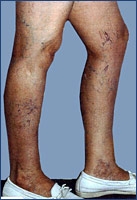
The photograph above shows spider veins on the legs.
Spider veins usually take on one of three basic patterns:
- They may appear as thin separate lines
- They may be arborizing and will resemble tiny branch-like shapes
- or they may appear in a true spider shape with a group of veins radiating outward from a dark central point
Linear spider veins are commonly seen on the inner knee, whereas the arborizing pattern often appears on the outer thigh in a sunburst or cartwheel distribution.
What Causes Spider Veins ?
There are several schools of thought on exactly what causes spider veins.One theory is that spider veins, which occur near the surface of the skin, are fed by underlying varicose veins too small or embedded too deeply to enable them to reach the skin surface. These underlying veins disrupt circulation, causing spider veins to grow above them.
Another theory is that spider veins are little arteries that have joined the network of veins nearest the skin surface. Because arteries are highly pressurised and the surface veins have low pressure, the combination of the arterial blood (oxygenated blood flowing from the heart) with the venous blood (deoxygenated blood flowing toward the heart) causes spider veins to be visible.
How Do I Know if I Have Spider Veins?
There are many sufferers that complain of no discomfort at all. However, some patients will experience aching, a “heavy” feeling and legs that tire easily. These symptoms tend to worsening throughout the day. Relief comes with walking or elevating the legs. Complaints may worsen with menstruation and warmer weather. Facial veins are principally painless but can be unsightly. Symptoms associated with spider veins may include:
- Itching
- Throbbing pain
- Night cramps
- Tiredness
- A feeling of self-consciousness
- Tingling
- Heaviness in legs
Who Is Affected By Spider Veins?
Spider veins appear to be hormonally induced and often are associated with pregnancy and menstruation. Women develop spider veins nearly four times as frequently as men. In fact, about three out of four adult women are affected with spider veins at some time in their lives. Some women are at greater risk due to hereditary factors; others are predisposed to spider veins because of their lifestyle.
There are several factors that can increase the risk of spider veins:
- Old injuries
- Genetic - there is growing evidence that spider veins can be hereditary
- Occupations – that involve prolonged standing or sitting
- Obesity - develop circulatory problems, diabetes and heart disease, all of which hinder the flow of blood from the veins to the heart
- Pregnancy – hormonal changes and general stress on the body
- Use of oral contraceptives
- Post menopausal hormone replacement
- Blood clots – people with a history of blood clots
- Medical conditions – that may increase intra-abdominal pressure such as constipation, also topical steroids
- Sun – over exposure to ultra-violet rays
- Lifestyle – wearing of tight fitting garments and high-heel shoes