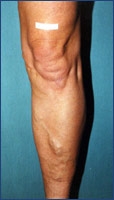
Varicose veins are twisted, enlarged veins, often dark blue in color, near or raised above the surface of the skin. Varicose veins are often a symptom of an underlying condition called venous insufficiency. Varicose veins do not occur suddenly; it usually takes years for symptoms to develop.
 In healthy veins, one way valves direct the flow of venous blood upward and inward. Blood is collected in superficial small veins and flows into larger veins. The blood eventually passes through valves into the deep veins and then centrally to the heart and lungs.
When one or more of these valves fail to function correctly or leaks, some blood flows down the leg, in the reverse direction. The blood tends to overfill and stretch the branches of superficial veins under the skin. Deep veins can withstand this pressure because of their construction and because the surrounding conforming muscle prevents the veins from becoming excessively stretched.
Over time, this additional venous blood pressure causes the veins to stretch, bulge, and become visible. Continued exposure to high pressure can cause superficial veins of any size to become dilated and twisted.